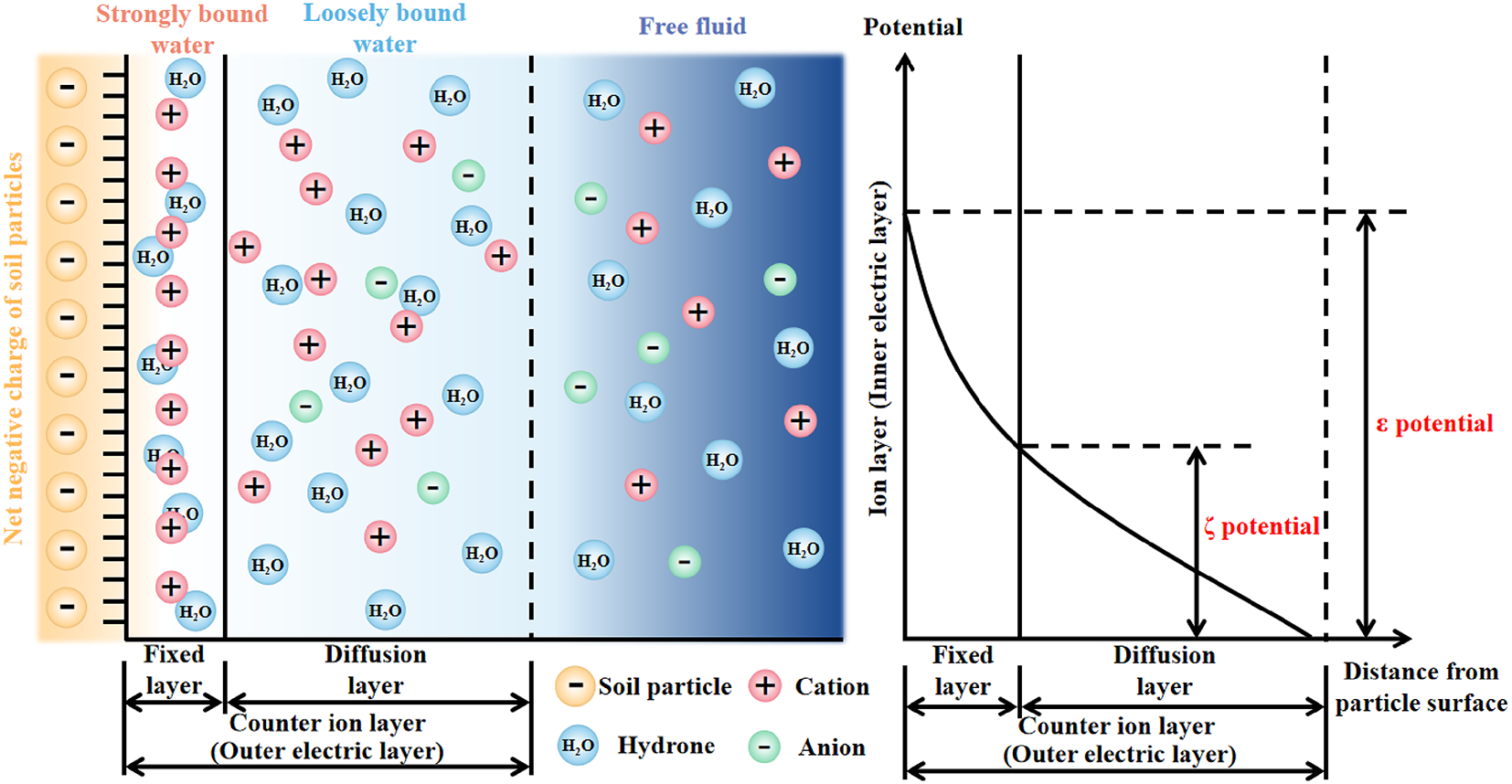
Zeta Potential and Particle Interactions Explained

Zeta potential is the electric potential at the hydrodynamic slipping plane of a particle and quantifies electrokinetic interactions in dispersion Zeta Potential. It differs from surface charge, which is the net charge on surface sites and adsorbed ions that structures the Stern layer. Measured via electrophoretic mobility or electroacoustic methods, zeta potential predicts repulsion range influenced by pH, ionic strength, and adsorbed layers. Control uses surfactants, salts, or polymers to tune stability. Further sections explain measurement models and practical control strategies.

Zeta Potential Change and curing effects on Shield Muck solidified by Metal  Ion Complex Catalysis | Scientific Reports

What Zeta Potential Is and How It Differs From Surface Charge

In colloidal systems, zeta potential denotes the electric potential at the slipping plane—the notional boundary between the stationary layer of fluid attached to a particle surface and the mobile diffuse layer—whereas surface charge refers to the actual net electric charge residing on the particle’s surface atoms or adsorbed ions Lab Alliance. The distinction controls stability: surface charge establishes the static field and the dynamic Sternlayer organizes specifically adsorbed ions; zeta potential reflects electrokinetic slip and the effective field felt during particle motion. Operators adjust chemistry to target zeta rather than total surface charge, since interfacial structure and ion binding decouple the two quantities.

How Zeta Potential Is Measured and Interpreted

Using electrophoretic mobility measurements and electroacoustic methods, zeta potential is determined by quantifying the motion or field-induced response of particles under an applied electric field and converting that response into an electric potential at the slipping plane via models such as the Smoluchowski or Henry equations. Measurements include electrophoresis, electroacoustic spectroscopy, and streaming potential measurements. Interpretation requires model selection, correction for particle size and dielectric properties, and assessment of signal-to-noise. Reported values guide control strategies for stabilization or aggregation suppression.

Method Observable Key consideration
Electrophoresis Mobility Particle size correction
Electroacoustic spectroscopy Field response Concentrated dispersions
Streaming potential measurements Potential Flow coupling

Effects of Ph and Ionic Strength on Particle Stability

Measurements of zeta potential provide a quantitative basis for predicting how pH and ionic strength modulate colloidal stability. pH alters surface charge through protonation/deprotonation of surface functional groups, shifting the zeta potential and possibly passing through an isoelectric point where electrostatic repulsion vanishes. Controlled pH titration maps charge versus pH, identifying stability windows. Increasing ionic strength compresses the electrical double layer via ionic screening, reducing repulsive range and promoting aggregation despite similar surface charge. Practical control combines targeted pH titration with electrolyte selection to tune zeta potential magnitude and Debye length, thereby governing suspension stability and process reproducibility.

What is zeta potential and its importance? | Perla Edith Vega Guerrero  posted on the topic | LinkedIn

Role of Surface Chemistry and Adsorbed Layers

With specific surface chemistries and adsorbed layers dictating interfacial charge distribution and steric profiles, particle interactions are governed not only by intrinsic functional groups but also by the composition and conformation of adsorbates. Surface acid/base sites set baseline charge, while adsorbed ions and neutral molecules modify the electrical double layer and compressibility. Polymer brushes impart steric stabilization, tune hydration, and shift apparent zeta potential through layer thickness and grafting density. Ligand exchange alters surface coordination, chargeability, and affinity for counterions, enabling controlled shifts in interaction range and specificity. Precise characterization of layer architecture is essential for predictive interaction modeling.

Practical Strategies to Control and Use Zeta Potential

By adjusting surface chemistry, ionic environment, and adsorbed layers, practitioners can actively tune zeta potential to achieve desired colloidal stability, selective aggregation, or interfacial transport. Control strategies target surface charge magnitude, double-layer thickness, and specific adsorption. Techniques include adjusting surfactants, pH titration, salt concentration modulation, and polymer grafting to alter electrostatic screening and steric repulsion. Monitoring uses electrophoretic mobility and titration curves for setpoint validation. Practical workflow emphasizes reproducibility, minimal additives, and reversible adjustments when possible.

  • Modify surfactant type/concentration for charge sign and magnitude
  • Tune ionic strength to control electrostatic screening
  • Apply polymers for steric stabilization and targeted bridging

Conclusion

Zeta potential quantifies the effective electrokinetic charge at the slipping plane and differs from intrinsic surface charge by incorporating adsorbed ions and solvent structure. Measured via electrophoretic mobility and interpreted using electrokinetic models, it predicts colloidal stability influenced strongly by pH and ionic strength. Surface chemistry and adsorbed layers modulate the potential and interaction forces. Controlled adjustment of zeta potential enables predictable aggregation, dispersion, and interfacial behavior in formulation, separation, and processing applications.

Read More

How to Tell If You Have Dust Mites or Bed Bugs at Home

Dust mite exposure shows persistent indoor allergy symptoms—sneezing, itchy eyes, congestion and worse mornings—plus dusty fabric, fine powdery debris and high humidity in mattresses and upholstery. Bed bugs cause clustered, linear welts pest control for rats, immediate localized swelling and visible evidence: rust-colored stains, dark fecal specks, tiny eggs, shed skins or live reddish-brown insects in seams and crevices. Inspect mattress seams, bed frames and nearby furniture with a flashlight. Continue for practical checks, documentation and proven control steps.
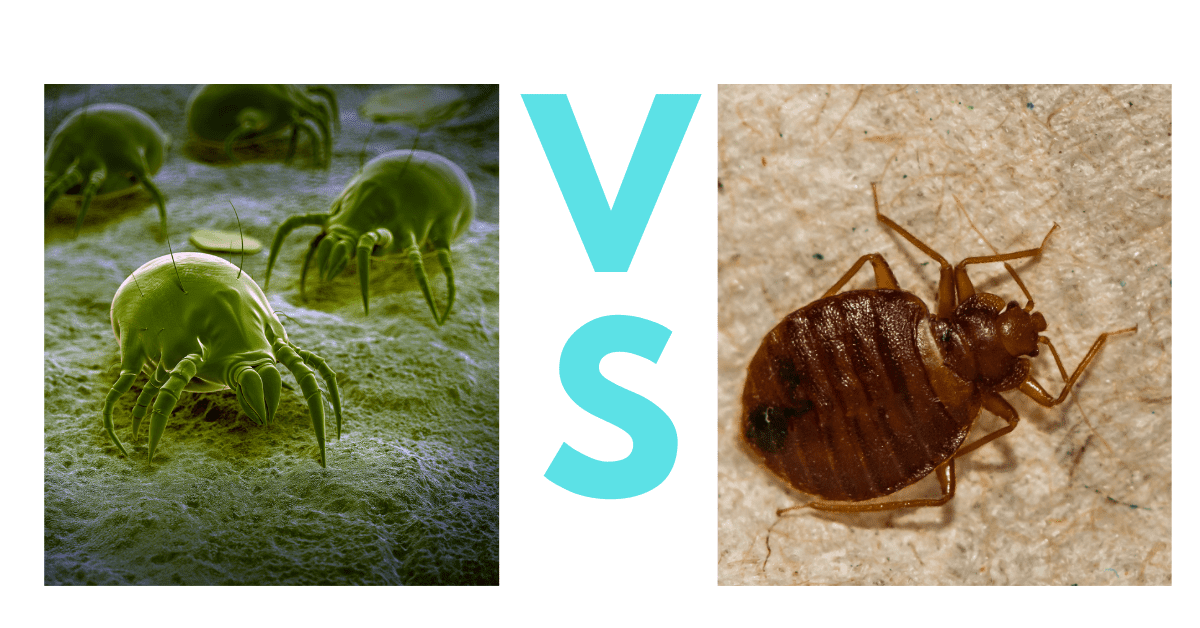
Dust Mites VS Bed Bugs: A Complete Guide with Photos

What Dust Mites Are and Where They Live

In household environments, dust mites are microscopic arachnids of the family Pyroglyphidae that feed primarily on shed human skin and organic detritus igreenasia. They colonize mattresses, pillows, upholstered furniture, carpets, and curtains where humidity and warmth persist. Their distribution concentrates in high-contact fabrics and seams, favoring environments with relative humidity above 50%. Detection relies on indirect indicators — allergy symptoms, accumulated fine dust, and targeted microscopic observation of collected dust samples in laboratory or field-portable microscopes. Management emphasizes allergen mitigation through engineered interventions: encasements, HEPA filtration, humidity control, regular laundering at high temperatures, and material choices that reduce dust accumulation. Research and product development focus on scalable, low-energy systems that integrate monitoring and automated mitigation for resilient indoor environments.

What Bed Bugs Are and Where They Hide

Detects human hosts by carbon dioxide and warmth, bed bugs (Cimex lectularius and related species) are small, wingless, blood-feeding insects active at night and skilled at hiding in tight, protected crevices near sleeping areas. They prefer seams and folds — mattress seams, box-spring edges, bed frames — but exploit any cluttered microhabitat offering darkness and proximity to hosts. Modern infestations leverage travel and used furniture; insects disperse by crawling, not flying, and can spread between rooms through voids. Inspections should include headboards, baseboards, upholstered furniture, luggage, and seldom-considered refuges such as electrical outlets and wall voids. Innovative mitigation prioritizes targeted detection: focused visual searches, interceptors under legs, and sealed encasements to isolate harborage and reduce chemical use while preserving human-safe environments.

Signs of Dust Mite Presence in Your Home

Commonly overlooked, dust mite presence is indicated less by seeing the mites themselves and more by a pattern of symptoms and environmental clues: persistent indoor allergy symptoms (sneezing, itchy or watery eyes, nasal congestion, coughing, or wheezing), increased symptoms on waking or in bedrooms, visible dust accumulation on soft furnishings, and fine powdery debris when pillows or mattresses are disturbed. A pragmatic occupant notes symptom patterns, documents timing, and considers allergy testing to confirm sensitization. Practical interventions include targeted cleaning, encasing bedding, and upgrading air filtration to reduce airborne allergens. Emotional response can motivate action:

  • Frustration at nightly irritation prompting decisive change.
  • Relief when measurable testing guides solutions.
  • Urgency to adopt innovative air filtration and fabric barriers.

Dust Mites vs Bed Bugs: Which One Do You Have? (Maybe Both 😅)

Signs of Bed Bug Infestation to Look For

Behind and beneath bedroom surfaces, bed bug infestations reveal themselves through a distinct set of physical and behavioral clues: small rust-colored stains or dark specks of fecal matter on sheets, mattress seams, and headboards; tiny pale eggs or translucent shed skins in creases and joints; clusters of live, reddish-brown, flat-bodied insects about the size of an apple seed; and an uptick in unexplained itchy, linear bites appearing after periods spent at home. Inspectors should expand checks to cracks, electrical outlets, furniture joints, and luggage. Use LED flashlights, magnifiers, and portable inspection tools to map harborages and document findings. Early detection enables targeted interventions; when evidence is confirmed or widespread, engage professional extermination to assure effective removal and reduce reinfestation risk.

Differences in Bite Patterns and Symptoms

Frequently, bite patterns and symptoms provide the clearest initial distinction between bed bugs and dust mites. Bed bug bites often appear as clustered, linear welts with immediate redness and localized swelling; they reveal an organized itch distribution tied to exposed skin. Dust mite reactions tend to be diffuse — widespread itching, sneezing, and eczema-like irritation driven by allergen exposure rather than discrete bites. Delayed itch is common with dust mite sensitivity, where symptoms worsen hours after exposure. Clinicians and innovators favor symptom mapping to prioritize interventions.

  • The unsettling certainty of waking with linear welts.
  • The slow dread as allergy-driven itching escalates.
  • The clinical relief of identifying a clear pattern.

This pragmatic contrast guides targeted mitigation and next-step diagnostics.

Simple Home Checks to Identify Which Pest You Have

A quick visual inspection can distinguish common signs: bed bug bites often appear in clustered or linear patterns on exposed skin, while dust mite reactions are more diffuse and associated with eczema-like redness. Examine bedding and mattress seams for tiny dark spots or shed skins that indicate bed bugs, and scan pillows and fabric surfaces for fine, sand-like particles or dust buildup that suggest dust mites. Follow these checks with targeted cleaning or professional assessment as needed.

Visible Bites or Marks

How can homeowners tell whether bites or marks come from dust mites or bed bugs? Observable marks differ: dust mites rarely bite but can trigger allergic reactions and skin rashes, presenting as diffuse redness, itching, or eczema-like patches. Bed bug bites typically appear as clustered, linear welts, often on exposed skin after sleep.

  • Immediate unease: clustered welts suggest an active bed bug problem, prompting swift action.
  • Frustration: widespread, patchy rashes point toward allergens and environmental control measures.
  • Urgency: worsening inflammation or infection requires professional assessment.

A pragmatic approach: document marks with photos, note timing and locations, and consult a clinician to distinguish allergic reactions from insect bites. Use targeted inspection and innovative mitigation accordingly.

Look for Tiny Particles

Small, visible particles around sleeping areas offer clear clues: dark specks, rust-colored stains, or tiny shells point toward bed bugs, while fine, powdery dust and shed microscopic skin fragments suggest dust mite activity. Observers should scan seams, creases, and edges of mattresses and furniture for clustered dark flecks or minute eggshells; these indicate blood-fed bed bugs and correlate with fabric discoloration where feeding or excretions occurred. Conversely, a diffuse layer of microscopic debris across pillows, blankets, and upholstery signals high dust mite presence. Innovative inspection tools—LED magnifiers, adhesive tape lifts, or a controlled vacuum filter—help distinguish particle types quickly. Document findings, noting location and concentration, then prioritize targeted interventions: mattress encasements and heat treatment for bed bugs, deep-cleaning and humidity control for dust mites.

Treatment and Prevention for Dust Mites

Effective control of dust mites focuses on reducing indoor humidity and routine laundering of bedding. Maintaining relative humidity below 50% inhibits mite survival, achievable with dehumidifiers or improved ventilation. Washing sheets and pillowcases in hot water (at least 130°F/54°C) on a weekly basis removes allergens and resets infestations.

Reduce Indoor Humidity

By lowering indoor humidity to below about 50%, households can sharply reduce dust mite populations because mites require moist air to survive and reproduce. Effective humidity control combines smart dehumidifier placement, improved air circulation, and routine monitoring with moisture meters. Placement near moisture sources and open pathways for airflow maximizes efficiency; innovative units with sensors automate response. The approach is low-impact, scalable, and data-driven.

  • Quiet, hidden control restores comfort and health.
  • Visible meters provide satisfying, immediate feedback.
  • Strategic devices reduce worry and long-term costs.

This practical system prioritizes measurable results: set targets, place units for optimal circulation, read meters regularly, and adjust settings. The result is a durable reduction in mite habitat without chemical interventions.

Wash Bedding Hot

Controlling humidity helps weaken dust mite populations, but direct laundering of bedding provides an immediate, reliable kill step: washing sheets, pillowcases, blankets and mattress covers in water at least 130°F (54°C) for 10–15 minutes reliably kills mites and denatures allergens. Hot washing is the most practical, evidence-based intervention for rapid reduction of viable mites and allergenic proteins. For innovation-minded households, integrate programmable machines or sanitizing cycles that guarantee temperature and duration, and use high-efficiency detergents with enzymatic action to aid allergen breakdown. Repeat weekly for high-exposure sleepers; biweekly suffices for low exposure. Include washable mattress encasements and pillow protectors in the rotation. Dry items thoroughly at high heat. Combine bedding sanitization with humidity control and vacuum filtration for a scalable, measurable reduction in mite burden.

Treatment and Control Options for Bed Bugs

Addressing a bed bug infestation requires a coordinated approach that combines inspection, targeted treatments, and follow-up monitoring to guarantee elimination and prevent reintroduction. A professional extermination assessment is advised to map harborage sites, evaluate chemical and heat options, and advise on legal responsibilities when treating rented properties. Integrated tactics—encasements, heat treatments, targeted residuals, and meticulous laundering—minimize spread and resistance. Tenacious follow-up inspections confirm success.

A coordinated, evidence-based pest plan—inspection, targeted treatments, encasements, heat, laundering, and rigorous follow-up—to eliminate bed bugs and prevent return.

  • Fear of bites and sleepless nights can motivate swift, decisive action.
  • Frustration with recurring infestations drives demand for innovative, science-backed solutions.
  • Relief comes from verified eradication and clear compliance with landlord-tenant rules.

Decision-makers should prioritize evidence-based methods, vendor credentials, and documented treatment plans.

Conclusion

Determining whether a home harbors dust mites or bed bugs relies on recognizing distinct evidence and responses. Dust mites are microscopic, trigger allergy symptoms, and leave no visible marks; bed bugs are visible at certain life stages, produce blood spots, shed skins and itchy clustered bites. Practical inspection—mattresses, seams, crevices—and symptom tracking guide identification. Remedial actions differ: allergen reduction and cleaning for dust mites; targeted extermination and isolation for bed bugs. Prompt, appropriate intervention prevents escalation.

Read More

Design Tips for LED Video Walls: Scale, Resolution, and Content Strategy

A practical LED video wall strategy ties pixel pitch to expected viewing distance, balancing cost, weight, and service access LED panel. Typography favors high x‑height geometric sans serifs, bold weights, and wide tracking to overcome optical blur. Color and luminance are hardware‑calibrated with WCAG‑aware contrast targets. Motion pacing uses slow, layered kinetics with static anchors for legibility. Modular layouts impose seam and safe‑zone rules and export templates. Playback aligns refresh, codecs, and bitrate for artifact‑free display — further guidance follows.

Video Wall Content Design Ideas

Choosing the Right Pixel Pitch for Viewing Distance

How close should viewers stand to an LED video wall to maintain image fidelity? The designer evaluates angular resolution versus pixel density to determine ideal pitch for expected viewing distances. Calculations translate human visual acuity into minimum viewing distance; smaller pitch permits closer proximity without visible pixelation, larger pitch suits distant audiences. Ambient considerations—lighting LED display board Malaysia, reflections, and sightlines—modify required contrast and can push specifications toward finer or coarser pitch. Mounting height and venue scale influence acceptable viewing cones and the number of simultaneous clear sightlines. Procurement balances cost, weight, and serviceability against pixel density to preserve freedom in content placement. Final selection documents target viewing zones and recommends pixel pitch ranges matched to measured audience distances.

Designing for Readability: Text, Contrast, and Color

Having set pixel pitch to match audience distance and viewing cones, attention shifts to typographic legibilitycontrast ratios, and color fidelity—parameters that determine whether content reads correctly from planned sightlines. Designers prioritize type weight, x-height, and tracking; bold, geometric sans-serifs increase read distance while minimizing optical blur. Color management aligns LED calibration with source profiles to preserve hue and saturation under ambient light. Practical legibility testing uses real-world mockups at target distances. Accessibility contrast targets are verified with measurement tools and WCAG-aligned thresholds to guarantee inclusivity without sacrificing creative freedom.

  1. Use generous x-height and weight for distant text.
  2. Enforce accessibility contrast using calibrated meters.
  3. Validate color fidelity with hardware LUTs and profiles.
  4. Perform staged legibility testing with live viewers.

Composing Motion and Static Content for Impact

In composing motion and static content for LED video walls, designers must balance temporal dynamicsspatial hierarchy, and legibility to guarantee each frame reads correctly from intended vantage points. The workflow separates static anchors and kinetic layers: static imagery establishes image hierarchy and brand presence, while motion elements provide rhythm and call-to-action emphasis. Motion pacing should align with viewing distance and dwell time; slower, pronounced movement suits distant viewers, quicker shifts suit close-in, transient audiences. Contrast, scale, and negative space reinforce focal points without adding complexity. Technical delivery relies on predictable loop lengths, frame-accurate cues, and GPU-optimized assets to avoid judder. Testing at scale verifies perceived timing and hierarchy so content maintains impact under variable ambient conditions and viewer behavior.

Sixteen:Nine | All Digital Signage, Some Snark

Planning Layouts and Safe Zones for Modular Walls

With motion and static layers defined, layout planning for modular LED walls maps content to physical modules and establishes safe zones that respect seams, mounting hardware, and viewer sightlines. The planner defines grid templates that mirror cabinet boundaries, applying module alignment rules so critical imagery never crosses seams. Safe zones reserve margins for connectors, mounting tolerances, and accessible panels. Edge blending is considered where panels overlap visually or when curved arrays require soft shifts. Sightline studies set vertical and horizontal limits for readable text and primary motion anchors. Export templates include guides for cropping, bleed, and registration marks so designers retain creative freedom while protecting legibility and hardware.

  1. Define cabinet grid and module alignment
  2. Set seam and connector safe zones
  3. Plan edge blending regions
  4. Run sightline-readability checks

Playback Strategy: Brightness, Refresh, and File Optimization

Frequently, playback strategy balances three technical domains—brightness management, refresh-rate timing, and file optimization—to guarantee images remain stable, legible, and artifact-free on modular LED walls. The designer calibrates luminance to ambient conditions, setting zones and profiles that preserve contrast without clipping and enable viewer agency over intensity. Refresh-rate timing aligns source frame rates with panel controllers to prevent judder and temporal aliasing; test vectors reveal peak sync points for motion clarity. File compression is applied judiciously: visually lossless codecs, intra-frame encoding, and controlled bitrate ceilings reduce storage and bandwidth while avoiding blockiness on large pixels. Workflow automation exports tailored masters per wall resolution and playback device, ensuring consistent, liberated content presentation across varied installations.

Frequently Asked Questions

What Maintenance Schedule Keeps LED Panels Performing Optimally?

They recommend daily inspections for pixel, seam, and airflow checks; weekly cleaning; monthly firmware updates, thermal imaging, and power audits; quarterly color calibration and spare-module swaps; annual full-system overhaul to preserve brightness, alignment, and operational freedom.

How Do I Integrate LED Walls With Live Video Feeds?

They route camera feeds through dedicated capture hardware and flexible camera routing, synchronize clocks and frame buffers for tight latency management, preview and color-match on-site, and enable operator override to maintain creative freedom during live mixes.

What Power and Cooling Requirements Do Large LED Walls Need?

Large LED walls require robust power distribution and active thermal management; designers specify redundant feeds, UPS, circuit balancing, high-efficiency PSUs, forced-air or liquid cooling, temperature monitoring, and ventilation planning to preserve brightness, freedom of placement, and reliability.

Are There Mounting and Structural Considerations for Outdoor Installations?

Yes. He evaluates mounting and structural considerations for outdoor installations: foundations, wind load calculations, anchoring redundancies, access for maintenance, and corrosion protection coatings; integrates flexible mounting options to maximize placement freedom and visual impact.

How Can I Secure LED Walls From Unauthorized Content Access?

Implement robust access controls and network segmentation to prevent unauthorized content deployment. The operator enforces role-based credentials, encrypted channels, firewall rules, VLANs, and physical lockouts, visualizing trust zones and audit trails for resilient, freedom-preserving control.

Conclusion

Selecting appropriate pixel pitch, optimizing text contrast and color, balancing motion with static imagery, and defining modular safe zones together guarantee LED video walls perform reliably and communicate effectively. Technical choices — viewing-distance–matched resolution, readable typography, calibrated brightness and refresh, and optimized media formats — reduce visual artifacts and operational load. A deliberate layout and playback strategy preserves legibility, minimizes power and bandwidth demands, and maximizes audience impact across installation scales and environments.

Read More