
A practical LED video wall strategy ties pixel pitch to expected viewing distance, balancing cost, weight, and service access LED panel. Typography favors high x‑height geometric sans serifs, bold weights, and wide tracking to overcome optical blur. Color and luminance are hardware‑calibrated with WCAG‑aware contrast targets. Motion pacing uses slow, layered kinetics with static anchors for legibility. Modular layouts impose seam and safe‑zone rules and export templates. Playback aligns refresh, codecs, and bitrate for artifact‑free display — further guidance follows.

Choosing the Right Pixel Pitch for Viewing Distance
How close should viewers stand to an LED video wall to maintain image fidelity? The designer evaluates angular resolution versus pixel density to determine ideal pitch for expected viewing distances. Calculations translate human visual acuity into minimum viewing distance; smaller pitch permits closer proximity without visible pixelation, larger pitch suits distant audiences. Ambient considerations—lighting LED display board Malaysia, reflections, and sightlines—modify required contrast and can push specifications toward finer or coarser pitch. Mounting height and venue scale influence acceptable viewing cones and the number of simultaneous clear sightlines. Procurement balances cost, weight, and serviceability against pixel density to preserve freedom in content placement. Final selection documents target viewing zones and recommends pixel pitch ranges matched to measured audience distances.
Designing for Readability: Text, Contrast, and Color
Having set pixel pitch to match audience distance and viewing cones, attention shifts to typographic legibility, contrast ratios, and color fidelity—parameters that determine whether content reads correctly from planned sightlines. Designers prioritize type weight, x-height, and tracking; bold, geometric sans-serifs increase read distance while minimizing optical blur. Color management aligns LED calibration with source profiles to preserve hue and saturation under ambient light. Practical legibility testing uses real-world mockups at target distances. Accessibility contrast targets are verified with measurement tools and WCAG-aligned thresholds to guarantee inclusivity without sacrificing creative freedom.
- Use generous x-height and weight for distant text.
- Enforce accessibility contrast using calibrated meters.
- Validate color fidelity with hardware LUTs and profiles.
- Perform staged legibility testing with live viewers.
Composing Motion and Static Content for Impact
In composing motion and static content for LED video walls, designers must balance temporal dynamics, spatial hierarchy, and legibility to guarantee each frame reads correctly from intended vantage points. The workflow separates static anchors and kinetic layers: static imagery establishes image hierarchy and brand presence, while motion elements provide rhythm and call-to-action emphasis. Motion pacing should align with viewing distance and dwell time; slower, pronounced movement suits distant viewers, quicker shifts suit close-in, transient audiences. Contrast, scale, and negative space reinforce focal points without adding complexity. Technical delivery relies on predictable loop lengths, frame-accurate cues, and GPU-optimized assets to avoid judder. Testing at scale verifies perceived timing and hierarchy so content maintains impact under variable ambient conditions and viewer behavior.
Planning Layouts and Safe Zones for Modular Walls
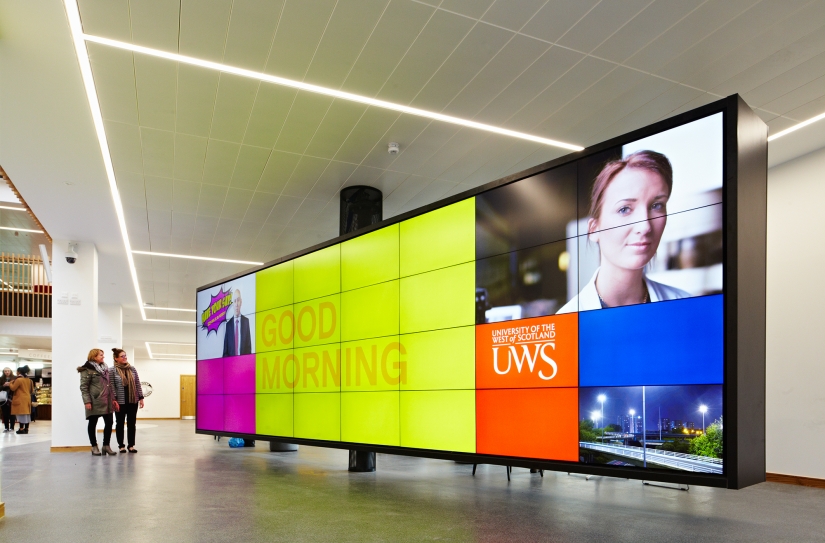
With motion and static layers defined, layout planning for modular LED walls maps content to physical modules and establishes safe zones that respect seams, mounting hardware, and viewer sightlines. The planner defines grid templates that mirror cabinet boundaries, applying module alignment rules so critical imagery never crosses seams. Safe zones reserve margins for connectors, mounting tolerances, and accessible panels. Edge blending is considered where panels overlap visually or when curved arrays require soft shifts. Sightline studies set vertical and horizontal limits for readable text and primary motion anchors. Export templates include guides for cropping, bleed, and registration marks so designers retain creative freedom while protecting legibility and hardware.
- Define cabinet grid and module alignment
- Set seam and connector safe zones
- Plan edge blending regions
- Run sightline-readability checks
Playback Strategy: Brightness, Refresh, and File Optimization
Frequently, playback strategy balances three technical domains—brightness management, refresh-rate timing, and file optimization—to guarantee images remain stable, legible, and artifact-free on modular LED walls. The designer calibrates luminance to ambient conditions, setting zones and profiles that preserve contrast without clipping and enable viewer agency over intensity. Refresh-rate timing aligns source frame rates with panel controllers to prevent judder and temporal aliasing; test vectors reveal peak sync points for motion clarity. File compression is applied judiciously: visually lossless codecs, intra-frame encoding, and controlled bitrate ceilings reduce storage and bandwidth while avoiding blockiness on large pixels. Workflow automation exports tailored masters per wall resolution and playback device, ensuring consistent, liberated content presentation across varied installations.
Frequently Asked Questions
What Maintenance Schedule Keeps LED Panels Performing Optimally?
They recommend daily inspections for pixel, seam, and airflow checks; weekly cleaning; monthly firmware updates, thermal imaging, and power audits; quarterly color calibration and spare-module swaps; annual full-system overhaul to preserve brightness, alignment, and operational freedom.
How Do I Integrate LED Walls With Live Video Feeds?
They route camera feeds through dedicated capture hardware and flexible camera routing, synchronize clocks and frame buffers for tight latency management, preview and color-match on-site, and enable operator override to maintain creative freedom during live mixes.
What Power and Cooling Requirements Do Large LED Walls Need?
Large LED walls require robust power distribution and active thermal management; designers specify redundant feeds, UPS, circuit balancing, high-efficiency PSUs, forced-air or liquid cooling, temperature monitoring, and ventilation planning to preserve brightness, freedom of placement, and reliability.
Are There Mounting and Structural Considerations for Outdoor Installations?
Yes. He evaluates mounting and structural considerations for outdoor installations: foundations, wind load calculations, anchoring redundancies, access for maintenance, and corrosion protection coatings; integrates flexible mounting options to maximize placement freedom and visual impact.
How Can I Secure LED Walls From Unauthorized Content Access?
Implement robust access controls and network segmentation to prevent unauthorized content deployment. The operator enforces role-based credentials, encrypted channels, firewall rules, VLANs, and physical lockouts, visualizing trust zones and audit trails for resilient, freedom-preserving control.
Conclusion
Selecting appropriate pixel pitch, optimizing text contrast and color, balancing motion with static imagery, and defining modular safe zones together guarantee LED video walls perform reliably and communicate effectively. Technical choices — viewing-distance–matched resolution, readable typography, calibrated brightness and refresh, and optimized media formats — reduce visual artifacts and operational load. A deliberate layout and playback strategy preserves legibility, minimizes power and bandwidth demands, and maximizes audience impact across installation scales and environments.