
Zeta potential is the electric potential at the hydrodynamic slipping plane of a particle and quantifies electrokinetic interactions in dispersion Zeta Potential. It differs from surface charge, which is the net charge on surface sites and adsorbed ions that structures the Stern layer. Measured via electrophoretic mobility or electroacoustic methods, zeta potential predicts repulsion range influenced by pH, ionic strength, and adsorbed layers. Control uses surfactants, salts, or polymers to tune stability. Further sections explain measurement models and practical control strategies.
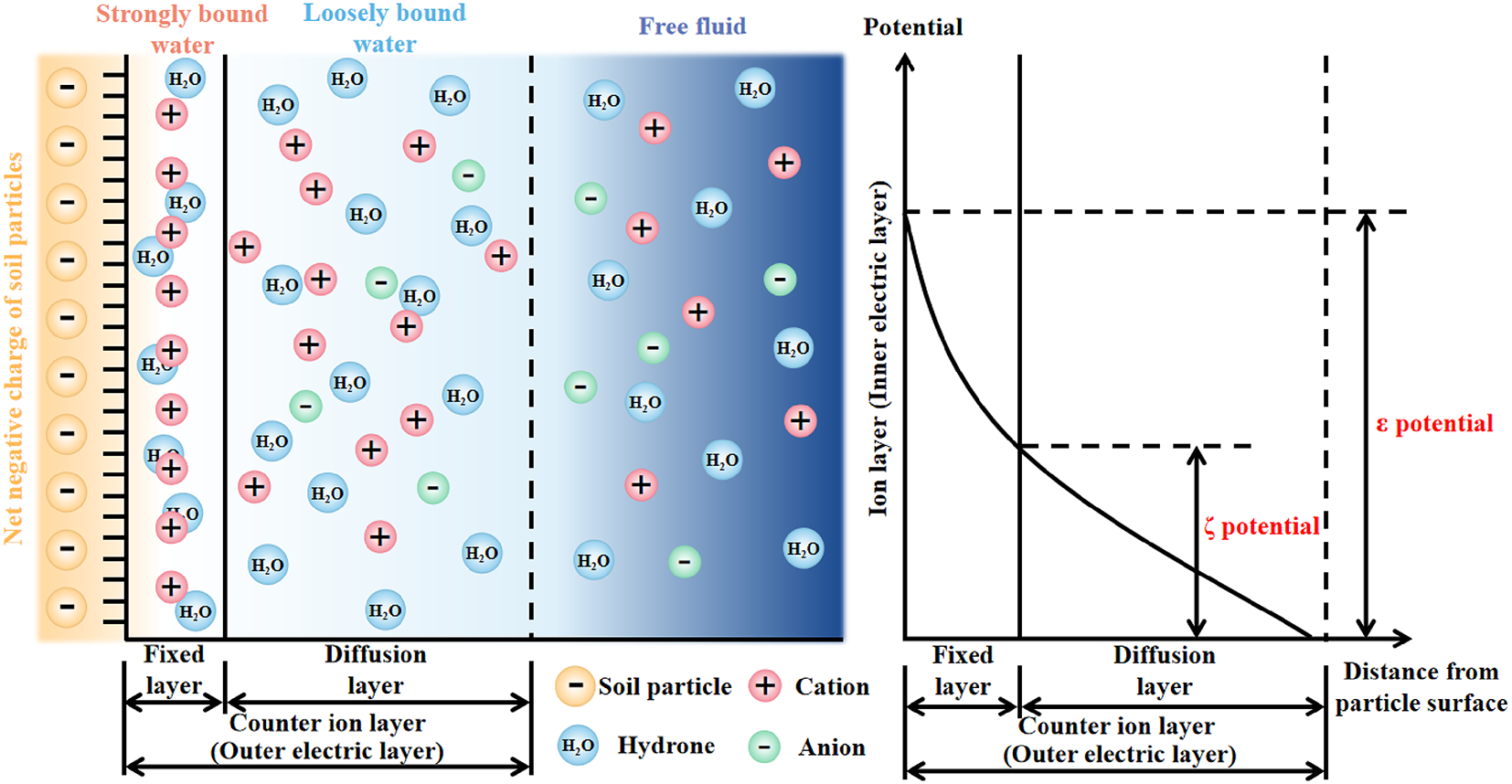
What Zeta Potential Is and How It Differs From Surface Charge
In colloidal systems, zeta potential denotes the electric potential at the slipping plane—the notional boundary between the stationary layer of fluid attached to a particle surface and the mobile diffuse layer—whereas surface charge refers to the actual net electric charge residing on the particle’s surface atoms or adsorbed ions Lab Alliance. The distinction controls stability: surface charge establishes the static field and the dynamic Sternlayer organizes specifically adsorbed ions; zeta potential reflects electrokinetic slip and the effective field felt during particle motion. Operators adjust chemistry to target zeta rather than total surface charge, since interfacial structure and ion binding decouple the two quantities.
How Zeta Potential Is Measured and Interpreted
Using electrophoretic mobility measurements and electroacoustic methods, zeta potential is determined by quantifying the motion or field-induced response of particles under an applied electric field and converting that response into an electric potential at the slipping plane via models such as the Smoluchowski or Henry equations. Measurements include electrophoresis, electroacoustic spectroscopy, and streaming potential measurements. Interpretation requires model selection, correction for particle size and dielectric properties, and assessment of signal-to-noise. Reported values guide control strategies for stabilization or aggregation suppression.
| Method | Observable | Key consideration |
|---|---|---|
| Electrophoresis | Mobility | Particle size correction |
| Electroacoustic spectroscopy | Field response | Concentrated dispersions |
| Streaming potential measurements | Potential | Flow coupling |
Effects of Ph and Ionic Strength on Particle Stability
Measurements of zeta potential provide a quantitative basis for predicting how pH and ionic strength modulate colloidal stability. pH alters surface charge through protonation/deprotonation of surface functional groups, shifting the zeta potential and possibly passing through an isoelectric point where electrostatic repulsion vanishes. Controlled pH titration maps charge versus pH, identifying stability windows. Increasing ionic strength compresses the electrical double layer via ionic screening, reducing repulsive range and promoting aggregation despite similar surface charge. Practical control combines targeted pH titration with electrolyte selection to tune zeta potential magnitude and Debye length, thereby governing suspension stability and process reproducibility.

Role of Surface Chemistry and Adsorbed Layers
With specific surface chemistries and adsorbed layers dictating interfacial charge distribution and steric profiles, particle interactions are governed not only by intrinsic functional groups but also by the composition and conformation of adsorbates. Surface acid/base sites set baseline charge, while adsorbed ions and neutral molecules modify the electrical double layer and compressibility. Polymer brushes impart steric stabilization, tune hydration, and shift apparent zeta potential through layer thickness and grafting density. Ligand exchange alters surface coordination, chargeability, and affinity for counterions, enabling controlled shifts in interaction range and specificity. Precise characterization of layer architecture is essential for predictive interaction modeling.
Practical Strategies to Control and Use Zeta Potential
By adjusting surface chemistry, ionic environment, and adsorbed layers, practitioners can actively tune zeta potential to achieve desired colloidal stability, selective aggregation, or interfacial transport. Control strategies target surface charge magnitude, double-layer thickness, and specific adsorption. Techniques include adjusting surfactants, pH titration, salt concentration modulation, and polymer grafting to alter electrostatic screening and steric repulsion. Monitoring uses electrophoretic mobility and titration curves for setpoint validation. Practical workflow emphasizes reproducibility, minimal additives, and reversible adjustments when possible.
- Modify surfactant type/concentration for charge sign and magnitude
- Tune ionic strength to control electrostatic screening
- Apply polymers for steric stabilization and targeted bridging
Conclusion
Zeta potential quantifies the effective electrokinetic charge at the slipping plane and differs from intrinsic surface charge by incorporating adsorbed ions and solvent structure. Measured via electrophoretic mobility and interpreted using electrokinetic models, it predicts colloidal stability influenced strongly by pH and ionic strength. Surface chemistry and adsorbed layers modulate the potential and interaction forces. Controlled adjustment of zeta potential enables predictable aggregation, dispersion, and interfacial behavior in formulation, separation, and processing applications.